Solution

A Solution to BMO1 2025, Problem 4

Methods Tangent chord theorem · Cyclic quadrilaterals · Reflection symmetry · Power of a point

BMO1 2025, Problem 4

Proposed by Gerry Leversha

In an acute triangle ABCABC with AB>ACAB>AC, let MM be the midpoint of BCBC. A circle through MM is tangent to ABAB at BB, and another circle through MM is tangent to ACAC at CC. The circles meet again at DD. Prove that

MA⋅MD=MB⋅MC.MA\cdot MD=MB\cdot MC.
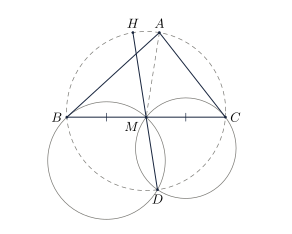
Acute triangle ABC with M the midpoint of BC. Two circles through M are tangent to AB at B and AC at C and meet again at D. The circumcircle of ABCD meets line DM again at H, the reflection of A across the perpendicular bisector of BC.

Solution

Proof

Working with directed angles modulo 180∘180^\circ, the tangent–chord theorem on the two given circles, together with the collinearity of B,M,CB,M,C, gives

∡BDC=∡BDM+∡MDC=∡ABM+∡MCA=∡BAC.\begin{aligned} \measuredangle BDC &=\measuredangle BDM+\measuredangle MDC\\ &=\measuredangle ABM+\measuredangle MCA\\ &=\measuredangle BAC. \end{aligned}

Hence A,B,C,DA,B,C,D lie on one circle Ω\Omega.

Extend DMDM through MM to meet Ω\Omega again at HH. Since D,M,HD,M,H and B,M,CB,M,C are collinear, the tangent–chord theorem on the circle through B,M,DB,M,D gives

∡BDH=∡BDM=∡ABM=∡ABC.\measuredangle BDH=\measuredangle BDM=\measuredangle ABM=\measuredangle ABC.

The first and last angles intercept the corresponding arcs BHBH and ACAC on the major arc BCBC, so

BH=AC.BH=AC.

Since MM is the midpoint of BCBC, reflection in the perpendicular bisector of BCBC fixes MM and interchanges these corresponding equal chords. It therefore sends HH to AA, giving

MH=MA.MH=MA.

Finally, the intersecting-chords theorem at MM gives

MB⋅MC=MD⋅MH=MD⋅MA.MB\cdot MC=MD\cdot MH=MD\cdot MA.

This proves the required identity.

□