Solution onlyDifficulty 6/10

A Solution to Crux Mathematicorum Problem 5088

A concise angle-chasing proof through tangency and cyclic quadrilaterals, presented without reproducing the original problem statement.

Methods Angle chasing · Cyclic quadrilaterals · Circle tangency · Orthogonal projections

The original problem statement is intentionally not reproduced here. This article follows its notation and presents only the independently prepared solution published here and its diagram. The complete statement is available in the official issue of Crux Mathematicorum.

Solution

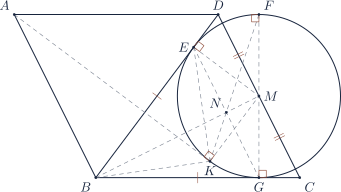
Parallelogram ABCD with BC equal to BD and M the midpoint of CD. E, F, and G are the perpendicular feet from M to the lines BD, AD, and BC. The circle centered at M passes through E, F, G, and K; AK is tangent at K, and N is the intersection of EG and BM.
Figure 1. The circle centered at M and the auxiliary points used in the proof.Select the diagram to enlarge it.

Proof

Let MM be the midpoint of CDCD. Let FF and GG be the feet of the perpendiculars from MM to ADAD and BCBC, respectively. Let N=EGBMN=EG\cap BM.

Since MD=MCMD=MC and MDF=MCB=EDM\measuredangle MDF=\measuredangle MCB=\measuredangle EDM, the three right triangles MDFMDF, MCGMCG, and MDEMDE are congruent. Hence EM=FM=GMEM=FM=GM, and EE, FF, GG, and KK lie on the circle ω\omega, centered at MM.

AA, KK, MM, and FF are concyclic, since AKM=AFM=π2\measuredangle AKM=\measuredangle AFM=\frac{\pi}{2}. Since BC=BDBC=BD and MM is the midpoint of CDCD, we have BMCDBM\perp CD, and hence BMABBM\perp AB. Therefore, AA, BB, MM, and FF are concyclic, since ABM=AFM=π2\measuredangle ABM=\measuredangle AFM=\frac{\pi}{2}. Thus AA, BB, FF, KK, and MM are concyclic.

Moreover, BGBG and BEBE are tangents to ω\omega at GG and EE, respectively. It follows that BNEGBN\perp EG.

Since FF, MM, and GG are collinear,

NEK=GEK=GFK=MFK=MBK=NBK.\begin{aligned} \measuredangle NEK &=\measuredangle GEK\\ &=\measuredangle GFK\\ &=\measuredangle MFK\\ &=\measuredangle MBK\\ &=\measuredangle NBK. \end{aligned}

Thus NN, KK, EE, and BB are concyclic. Therefore, BKE=BNE=π2\measuredangle BKE=\measuredangle BNE=\frac{\pi}{2}. This completes the proof.