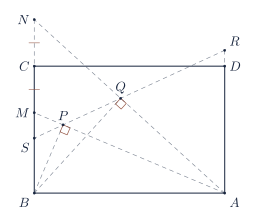
% Figure for Crux Mathematicorum Problem 5109
% Site: Elementary Geometry
% Website: https://elementarygeometry.org/
% Drawing tool: tkz-euclide
% Output format: SVG
% Last verified: 2026-08-23
%
% Editable source for public/diagrams/crux-5109-auxiliary-rectangle.svg.
% This sanitized drawing contains no source problem text or contact information.
% Accent target: fixed point R
% Publication Profile: scale 1.0.
% The web build does not compile TeX; export and review the SVG separately.
\documentclass[tikz,border=8pt]{standalone}
\usepackage{tkz-euclide}
\usetikzlibrary{intersections,calc,angles,quotes}

\definecolor{egNavy}{HTML}{17243D}
\definecolor{egGray}{HTML}{777671}
\definecolor{egRust}{HTML}{92513F}
\newcommand{\egUseStandardPlateAt}[1]{%
  \pgfresetboundingbox
  \path[use as bounding box]
    ([xshift=-102pt,yshift=-80pt]#1)
    rectangle
    ([xshift=102pt,yshift=80pt]#1);%
}
\newcommand{\egUseStandardPlate}{%
  \coordinate (egPlateCenter) at (current bounding box.center);%
  \egUseStandardPlateAt{egPlateCenter}%
}
\tikzset{
  eg figure/.style={line cap=round,line join=round,every node/.append style={font=\normalsize,text=egNavy}},
  eg main/.style={draw=egNavy,line width=0.75pt},
  eg support/.style={draw=egGray,line width=0.52pt},
  eg support dashed/.style={draw=egGray,line width=0.52pt,dash pattern=on 3pt off 3pt},
  eg accent/.style={draw=egRust,line width=0.75pt},
  eg mark/.style={draw=egNavy,line width=0.50pt}
}

\begin{document}
\begin{tikzpicture}[eg figure,scale=1.0]
  \tkzDefPoint(0,0){B}
  \tkzDefPoint(4.5,0){A}
  \tkzDefPoint(0,3){C}
  \tkzDefPoint(4.5,3){D}
  \tkzDefPoint(0,1.9){M}
  \tkzDefPointBy[symmetry=center C](M)\tkzGetPoint{N}

  \tkzDefLine[perpendicular=through B](A,M)
  \tkzGetPoint{b1}
  \tkzInterLL(A,M)(B,b1)
  \tkzGetPoint{P}
  \tkzDefLine[perpendicular=through B](A,N)
  \tkzGetPoint{b2}
  \tkzInterLL(A,N)(B,b2)
  \tkzGetPoint{Q}
  \tkzInterLL(P,Q)(B,C)\tkzGetPoint{S}
  \tkzInterLL(P,Q)(A,D)\tkzGetPoint{R}

  \tkzDrawSegments[eg support dashed](A,M A,N B,P B,Q R,D N,C)
  \tkzDrawSegments[eg main](B,A A,D D,C C,B R,S)
  \tkzMarkRightAngle[eg mark,size=0.18](B,P,A)
  \tkzMarkRightAngle[eg mark,size=0.18](B,Q,A)
  \tkzMarkSegment[color=egNavy,line width=0.50pt,mark=|](M,C)
  \tkzMarkSegment[color=egNavy,line width=0.50pt,mark=|](C,N)
  \tkzDrawPoints[color=egNavy,fill=egNavy,size=1.6](A,B,C,D,M,N,P,Q,S)
  \tkzDrawPoint[color=egRust,fill=egRust,size=1.6](R)
  \tkzLabelPoints[below right](A)
  \tkzLabelPoints[below left](B)
  \tkzLabelPoints[left](C,N)
  \tkzLabelPoints[left](M)
  \tkzLabelPoints[below left](S)
  \tkzLabelPoints[right](D)
  \tkzLabelPoints[above right](R)
  \tkzLabelPoints[above](P,Q)
  \egUseStandardPlate
\end{tikzpicture}
\end{document}