Problem 5109
Proposed by Ion Patrascu
Let be an isosceles right-angled triangle with . On the segment we consider the point to be mobile and denote by its symmetry with respect to . The points and are the projections of onto and , respectively. Prove that the line passes through a fixed point.
Solution
The condition is unnecessary.
For a nondegenerate position with , let be a point such that is a rectangle. Let
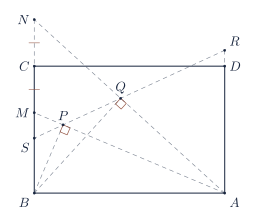
Proof
Since ,
Hence,
Similarly,
Here occur in this order. Therefore,
It follows that
Therefore, the line passes through the fixed point .
A projective generalization
More generally, the following proposition holds.
Proposition
Let be a nonsingular conic, and let and be distinct fixed points on . Let be a fixed line passing through , with . For a variable point , let be its conjugate under a fixed nonidentity projective involution on .
Let and be the second intersections of the lines and with , respectively, counted with multiplicity. Then, as varies along , the line passes through a fixed point. At a fixed point of the involution, is interpreted as the tangent to .
The original problem is the special case in which is the circle with diameter , is the line through perpendicular to , and the involution on is the reflection in .
Proof
Define a projectivity by letting be the second intersection of the line with .
The given involution on induces an involution on . Thus, if and are conjugate points on , then the corresponding points and are conjugate points of a fixed involution on .
A classical theorem in projective geometry states that the lines determined by conjugate pairs of an involution on a conic are concurrent. Hence the line passes through a fixed point.