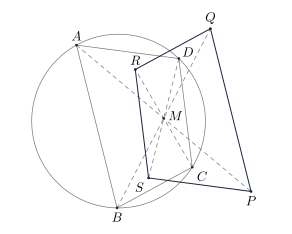
For a cyclic quadrilateral, the four orthocenters obtained by omitting one vertex at a time are the images of the original vertices under a single half-turn.
Let ABCD be a cyclic quadrilateral. Let P,Q,R,S be the orthocenters of the triangles BCD,CDA,DAB,ABC, respectively.
Then the segments
AP,BQ,CR,DS
have a common midpoint M. Equivalently, the half-turn centered at M sends
A↦P,B↦Q,C↦R,D↦S.
In particular,
ABCD≅PQRS.
Figure 1. The half-turn centered at M sends A, B, C, D to P, Q, R, S, respectively.
Proof
Let O be the center of the circumcircle of ABCD, and take O as the origin. Write
a,b,c,d
for the position vectors of A,B,C,D.
For a triangle inscribed in a circle centered at the origin, the orthocenter formula says that its position vector is the sum of its three vertex vectors. Therefore,
pqrs=b+c+d,=c+d+a,=d+a+b,=a+b+c.
Set
m=2a+b+c+d.
Then
pqrs=2m−a,=2m−b,=2m−c,=2m−d.
Thus M is the midpoint of each of AP,BQ,CR,DS. The half-turn, or central symmetry, centered at M therefore sends A,B,C,D to P,Q,R,S, respectively. In particular, the two quadrilaterals are congruent.
Source
This configuration appeared as Balkan Mathematical Olympiad 1984 (BMO 1984), Problem 2, where the stated conclusion was the congruence of the two quadrilaterals. The formulation above records the stronger half-turn relation given by the proof.