The theorem
Existence of the orthocenter
The three altitudes of a triangle are concurrent. Their common point is called the orthocenter of .
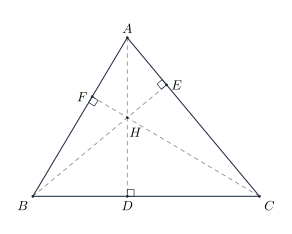
First view: two cyclic quadrilaterals
Let and be the feet of the altitudes from and on the lines and , respectively:
Let
Because
the four points lie on a circle. Also,
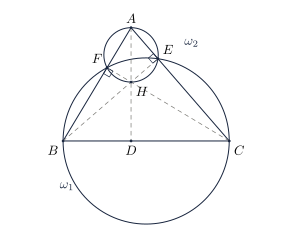
so the four points are also concyclic. In the configuration shown, the rays and , and , and and coincide. The two circles therefore give
By the converse of the inscribed-angle theorem, are concyclic. Hence
Therefore . The point lies on all three altitudes, and hence is the orthocenter of .
Second view: the circumcenter as origin
The vector proof begins from a different point of view. Instead of intersecting two altitudes and verifying the third, it constructs a point that lies on all three altitudes at once.
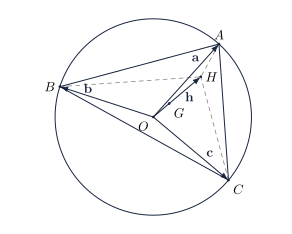
Let be the circumcenter of , and take as the origin. Write
Because lie on the circle centered at ,
Define a point by
We first show that . We have
Therefore
Hence . The same calculation, applied cyclically, gives
Thus is the orthocenter of .
The choice of origin is the key: because the vertex vectors have equal lengths, a sum such as is perpendicular to the corresponding difference . This makes the symmetric formula for natural.
The Euler line
Let be the centroid of . With the same origin , its position vector is
Comparing this with the vector of gives
Consequently, are collinear. Unless the triangle is equilateral,
In the equilateral case, the circumcenter, centroid, and orthocenter coincide.
The vector proof therefore contains the Euler line without an additional construction.
The two proofs are complementary. The synthetic proof shows how the two cyclic quadrilaterals created by the right angles force the third altitude through the intersection of the first two; the vector proof constructs the orthocenter symmetrically and leads directly to the Euler line.
Related notes and problems
The Centroid through Ceva and Vectors develops Ceva, isotomic conjugation, and the explicit vector construction of the centroid.
The Euler Line from the Medial Triangle gives a synthetic homothety proof of the same collinearity obtained here by vectors.
Four Orthocenters of a Cyclic Quadrilateral applies the orthocenter vector formula four times and reveals a hidden half-turn.
The Nine-Point Circle from the Circumcircle uses the unit-circle formula for the orthocenter to recover all nine classical points.
Simson’s Theorem uses two cyclic quadrilaterals to align three perpendicular feet, then extends the same argument to oblique projections.
Crux Mathematicorum Problem 5098 uses an orthocenter in a more specialized cyclic configuration.
Diagram and construction source
The three figures and their complete tkz-euclide sources are available in the diagram and construction record.