Problem 5098
Proposed by Mihaela Berindeanu; modified by the Editorial Board
Given a cyclic quadrilateral (with and separating from ) such that , define and to be the feet of the altitudes from and in triangle . Prove that the orthocenter of is the midpoint of if and only if is perpendicular to .
Solution
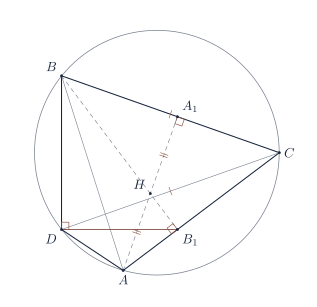
Proof
Work in the complex plane, and denote , , , , , , and . Take the circumcircle as the unit circle. Let , and . Then .
Since and the vertices are distinct, , with and . Moreover,
is the midpoint of if and only if
On the other hand, is perpendicular to if and only if
This completes the proof.