Classical

The Nine-Point Circle from the Circumcircle

Three formulas revealing one homothety

In the unit-circle model, three formulas for the side midpoints, altitude feet, and vertex–orthocenter midpoints reveal a single homothety carrying the circumcircle to the nine-point circle.

Methods Complex plane · Unit-circle normalization · Homothety · Orthogonal projections

The theorem

Theorem

Let OO and HH be the circumcenter and orthocenter of a triangle ABCABC, and let its circumradius be RR. The three side midpoints, the three altitude feet, and the midpoints of AH,BH,CHAH,BH,CH lie on a circle whose center is the midpoint of OHOH and whose radius is R/2R/2.

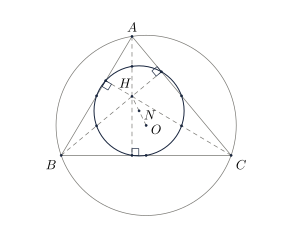
Triangle ABC with its three altitudes, circumcircle, and nine-point circle; the side midpoints, altitude feet, and vertex–orthocenter midpoints lie on the smaller circle, whose center N is the midpoint of OH.
Figure 1. The homothety centered at H with ratio 1/2 sends the circumcircle to the nine-point circle.

The unit-circle model

Place the circumcircle at

Γ:∣z∣=1\Gamma:\quad |z|=1

and take its center OO as the origin. Identify the Euclidean vector plane with the complex plane, and let the complex coordinates of A,B,CA,B,C be a,b,ca,b,c. Then

∣a∣=∣b∣=∣c∣=1.|a|=|b|=|c|=1.

Under this identification, the usual circumcenter-origin vector formula for the orthocenter gives

h=a+b+c.h=a+b+c.

Three formulas, one circle

Let NN be the point with coordinate

n=h2=a+b+c2,n=\frac h2=\frac{a+b+c}{2},

so NN is the midpoint of OHOH. Let eae_a, mam_a, and dad_a denote, respectively, the midpoint of AHAH, the midpoint of BCBC, and the foot of the altitude from AA. The first two formulas are immediate. In the unit-circle model, the standard formula for the foot of the altitude from AA gives the third:

ea=a+h2=2a+b+c2,ma=b+c2,da=12(a+b+c−aˉbc).\begin{aligned} e_a&=\frac{a+h}{2}=\frac{2a+b+c}{2},\\ m_a&=\frac{b+c}{2},\\ d_a&=\frac12\left(a+b+c-\bar a bc\right). \end{aligned}

Therefore

ea−n=a2,ma−n=−a2,da−n=−12aˉbc.e_a-n=\frac a2, \qquad m_a-n=-\frac a2, \qquad d_a-n=-\frac12\bar a bc.

Since ∣a∣=∣b∣=∣c∣=1|a|=|b|=|c|=1,

∣ea−n∣=∣ma−n∣=∣da−n∣=12.|e_a-n| =|m_a-n| =|d_a-n| =\frac12.

The cyclic formulas give the other six points. Thus all nine points lie on the circle

N:∣z−n∣=12,\mathcal N:\quad |z-n|=\frac12,

centered at NN with radius 1/21/2.

The homothety

Now define

T(w)=h+w2.T(w)=\frac{h+w}{2}.

Since T(w)=n+w/2T(w)=n+w/2,

T(Γ)={n+w2:∣w∣=1}=N.T(\Gamma) =\left\{n+\frac w2:|w|=1\right\} =\mathcal N.

In particular, the three triples

(a,b,c),(−a,−b,−c),(−aˉbc,−abˉc,−abcˉ)\begin{aligned} &(a,b,c),\\ &(-a,-b,-c),\\ &\left(-\bar a bc,-a\bar b c,-ab\bar c\right) \end{aligned}

on Γ\Gamma are sent respectively to the vertex–orthocenter midpoints, the side midpoints, and the altitude feet.

Finally,

T(w)−h=w−h2,T(w)-h=\frac{w-h}{2},

so TT is the homothety centered at HH with ratio 1/21/2. Returning from the unit-circle normalization, the radius of N\mathcal N is R/2R/2.