Napoleon’s theorem
Theorem
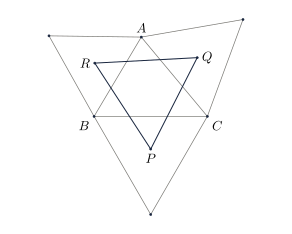
Construct outward equilateral triangles on the sides of a triangle , and let their centers be , respectively. Then is equilateral.
Proof
Identify the plane with the complex plane, orient counterclockwise, and write for the coordinates of its vertices. Multiplication by gives the outward normal to each directed side. The center of an equilateral triangle on a side of length lies at distance from the midpoint of that side. Hence the coordinates of are
Put
Direct subtraction gives
Thus the vector is carried to by a rotation through . The two vectors have the same length, and therefore is equilateral.
Van Aubel’s theorem
Theorem
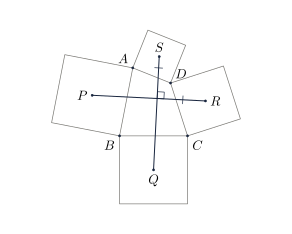
On the sides of a convex quadrilateral , construct squares externally, and let be their centers in the same order. Then the segments and are equal in length and perpendicular.
Proof
Write for the complex coordinates of the counterclockwise vertices . The center of the external square on an oriented side is obtained by adding half of its clockwise quarter-turn to the side midpoint. Consequently,
Subtracting the formulas above directly gives
Multiplication by is a quarter-turn and preserves length. Hence is perpendicular to and has the same length.
Both proofs encode each regular side construction as the midpoint of a side plus a fixed complex multiple of its side vector. After the endpoint terms are collected, the first calculation leaves a rotation between two sides of , while the second leaves a rotation between and .