Ceva’s theorem proves the concurrence of the medians and leads naturally to isotomic conjugation. Vectors locate the centroid and reveal why another triangle can share it.
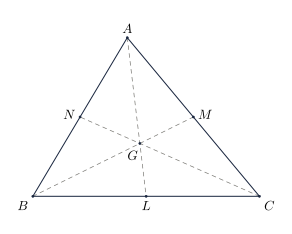
Let L,M,N be the midpoints of BC,CA,AB, respectively. Then the medians AL,BM,CN are concurrent at a point G, called the centroid of ABC.
The three medians of triangle ABC meet at G.
First proof: Ceva’s theorem
Because L,M,N are the midpoints of the three sides,
LCBL=1,MACM=1,NBAN=1.
Therefore,
LCBL⋅MACM⋅NBAN=1.
By the converse of Ceva’s theorem,
AL,BM,CN
are concurrent.
A further use of Ceva: isotomic conjugation
Before turning to vectors, the same product has a useful extension.
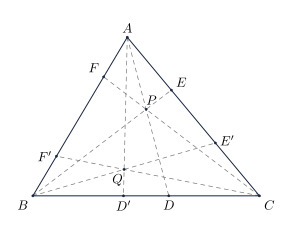
Let AD,BE,CF be cevians concurrent at an interior point P, where
D∈BC,E∈CA,F∈AB.
By Ceva’s theorem,
DCBD⋅EACE⋅FBAF=1.
Define D′∈BC, E′∈CA, and F′∈AB by reversing the three internal division ratios:
D′CBD′=BDDC,E′ACE′=CEEA,F′BAF′=AFFB.
Equivalently, D′, E′, and F′ are the reflections of D, E, and F in the midpoints of the corresponding sides.
Consequently,
D′CBD′⋅E′ACE′⋅F′BAF′=1.
The converse of Ceva’s theorem now shows that AD′,BE′,CF′ are concurrent. Their common point Q is the isotomic conjugate of P.
For the centroid, all three ratios are 1:1. Reversing them leaves each cevian foot unchanged, so the corresponding cevians are again the medians. The centroid is fixed by isotomic conjugation.
Ceva’s theorem beyond the centroid: reversing the three internal division ratios produces Q, the isotomic conjugate of P.
Second proof: vectors
Choose an arbitrary origin O, and write
OA=a,OB=b,OC=c.
Define G by
OG=g=3a+b+c=31a+32(2b+c).
Since (b+c)/2 is the position vector of the midpoint L of BC, this shows that G∈AL and GL:GA=1:2. Applying the same calculation cyclically places G on BM and CN. Hence the three medians are concurrent at G, with
G∈AL∩BM∩CN,GL:GA=GM:GB=GN:GC=1:2.
Viewed in terms of the three vertices, the same formula identifies G as their equal-weight affine average.
A further use of vectors: a shared centroid
Proposition
Let D∈BC, E∈CA, and F∈AB satisfy
BD:DC=CE:EA=AF:FB.
Then the triangles ABC and DEF have the same centroid.
Write the common ratio as r:s, where r,s>0. Their position vectors are
d=r+ssb+rc,e=r+ssc+ra,f=r+ssa+rb.
Therefore,
3d+e+f=3a+b+c=g.
This proves the proposition.
Related notes and diagrams
Two Views of the Orthocenter gives a circumcenter-based vector construction of the orthocenter and derives the Euler line.