The theorem
Theorem
Let lie on the circumcircle of triangle , and let be its perpendicular projections onto the lines , respectively. Then are collinear. Their line is the Simson line of with respect to .
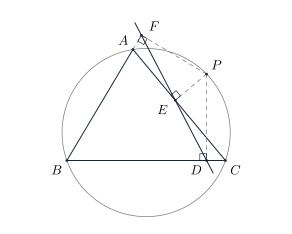
Two cyclic quadrilaterals
Use directed angles modulo , so that feet on side extensions are included.
The right angles show that and are cyclic: they lie on the circles with diameters and , respectively. Hence
where the last equality uses the circumcircle of , and
Therefore
Thus are collinear.
Carnot’s extension
The right angle can be replaced by any fixed angle , with , measured with the same orientation on all three sides. Take , , and such that the directed angles from to the corresponding sidelines are all .
The equal-angle condition still makes and cyclic. The same calculation therefore proves that are collinear. Taking recovers Simson’s theorem.
Related notes and diagrams
- Directed Angles explains the angle convention and cyclicity criterion used here.
- Two Views of the Orthocenter also uses the cyclic quadrilaterals created by perpendicular lines.
- Diagram and complete source