Problem 4941
Proposed by Michel Bataille
Let a non-equilateral triangle be inscribed in a circle with center . Its incircle , with center , touches , , and at , , and , respectively. The circle passes through and is tangent to at ; the circles and are defined cyclically. Prove that , , , and the line have a common point other than .
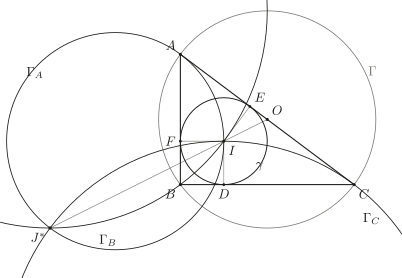
Main idea
Invert with respect to the incircle. The three circles become three lines, while , , and become the midpoints of the sides of the contact triangle. A negative homothety then reveals the point at which those lines meet.
Solution
Proof
We first treat the scalene case, in which all three circles , , and are nondegenerate.
Let
and let be the circumcenter of .
Since and , both and lie on the perpendicular bisector of . Thus is the midpoint of . Moreover, is the altitude to the hypotenuse of the right triangle , and hence
Cyclically,
Therefore, inversion in maps , , and to , , and , respectively.
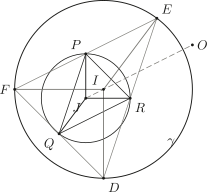
The points , , and are the midpoints of , , and . The homothety centered at the common centroid of and , with ratio , maps
It also maps the circumcenter of to the circumcenter of . Consequently,
The circumcircle of is mapped by the inversion to . The centers of two inverse circles are collinear with the center of inversion; hence , , and are collinear.
The points and are distinct. Indeed, if the incenter and circumcenter coincided, the three sides of would be chords at the same distance from the center of , so they would have equal lengths. The triangle would then be equilateral. We also have : otherwise the inverse of the circumcircle of would be centered at , forcing .
None of the lines , , and passes through . For example, suppose that . Since and , the lines and pass through the distinct points and , so they coincide. Since , the line has the same direction as ; as both pass through , they coincide. The angle bisector from would then also be perpendicular to , forcing , contrary to the scalene assumption. The other two cases are cyclic.
Let be the inverse of with respect to . A line not passing through the center of an inversion is mapped to a circle through that center, and the tangent to the image circle there is parallel to the original line. Thus , , and are mapped to , , and , respectively. The line is mapped to itself.
All four lines , , , and pass through . Their images therefore pass through . Since , the point is distinct from , which proves the result.