Classical

The Incenter through Trigonometric Ceva

Angle-bisector concurrence and isogonal conjugation

Trigonometric Ceva proves that the three internal angle bisectors concur and shows why isogonal reflection preserves concurrence.

Methods Trigonometric Ceva · Isogonal conjugation

The theorem

Theorem

Existence of the incenter

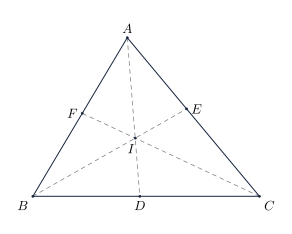
The three internal angle bisectors of a triangle ABCABC are concurrent. Their common point II is called the incenter of ABCABC.

Triangle ABC with D on BC, E on CA, and F on AB. The three internal angle-bisector cevians AD, BE, and CF meet at I.
The three internal angle bisectors of triangle ABC meet at I.

Trigonometric Ceva’s theorem

Let D,E,FD,E,F lie in the interiors of BC,CA,ABBC,CA,AB, respectively. For the three internal cevians AD,BE,CFAD,BE,CF, trigonometric Ceva’s theorem states that

AD,BE,CF are concurrent⟺sin⁡∠BADsin⁡∠DAC⋅sin⁡∠CBEsin⁡∠EBA⋅sin⁡∠ACFsin⁡∠FCB=1.AD,BE,CF\text{ are concurrent} \quad\Longleftrightarrow\quad \frac{\sin\angle BAD}{\sin\angle DAC} \cdot \frac{\sin\angle CBE}{\sin\angle EBA} \cdot \frac{\sin\angle ACF}{\sin\angle FCB} =1.

To see why, the sine rule gives

BDDC=ABACsin⁡∠BADsin⁡∠DAC,CEEA=BCBAsin⁡∠CBEsin⁡∠EBA,AFFB=CACBsin⁡∠ACFsin⁡∠FCB.\begin{aligned} \frac{BD}{DC} &=\frac{AB}{AC} \frac{\sin\angle BAD}{\sin\angle DAC},\\ \frac{CE}{EA} &=\frac{BC}{BA} \frac{\sin\angle CBE}{\sin\angle EBA},\\ \frac{AF}{FB} &=\frac{CA}{CB} \frac{\sin\angle ACF}{\sin\angle FCB}. \end{aligned}

After multiplication, the three side-length factors cancel. Ordinary Ceva’s theorem and its converse therefore prove trigonometric Ceva’s theorem.

Applying trigonometric Ceva

Now let AD,BE,CFAD,BE,CF be the three internal angle bisectors, with D,E,FD,E,F on the opposite sides. Then

∠BAD=∠DAC,∠CBE=∠EBA,∠ACF=∠FCB.\angle BAD=\angle DAC,\qquad \angle CBE=\angle EBA,\qquad \angle ACF=\angle FCB.

Each sine ratio in the trigonometric Ceva product is therefore equal to 11. By the converse, AD,BE,CFAD,BE,CF are concurrent. Denote their common point by II; this proves the existence of the incenter.

A further use of trigonometric Ceva: isogonal conjugation

Let the internal cevians AD,BE,CFAD,BE,CF concur at an interior point PP, where

D∈BC,E∈CA,F∈AB.D\in BC,\qquad E\in CA,\qquad F\in AB.

Reflect the cevian ADAD in the internal angle bisector at AA, and let the reflected line meet BCBC at D′D'. Define E′E' and F′F' cyclically. The reflection at AA gives

∠BAD′=∠DAC,∠D′AC=∠BAD,\angle BAD'=\angle DAC, \qquad \angle D'AC=\angle BAD,

and hence

sin⁡∠BAD′sin⁡∠D′AC=sin⁡∠DACsin⁡∠BAD.\frac{\sin\angle BAD'}{\sin\angle D'AC} = \frac{\sin\angle DAC}{\sin\angle BAD}.

The other two sine ratios are reversed in the same way. Since the original trigonometric Ceva product is 11, the reflected cevians satisfy

sin⁡∠BAD′sin⁡∠D′AC⋅sin⁡∠CBE′sin⁡∠E′BA⋅sin⁡∠ACF′sin⁡∠F′CB=1.\frac{\sin\angle BAD'}{\sin\angle D'AC} \cdot \frac{\sin\angle CBE'}{\sin\angle E'BA} \cdot \frac{\sin\angle ACF'}{\sin\angle F'CB} =1.

By the converse of trigonometric Ceva, AD′,BE′,CF′AD',BE',CF' are concurrent at a point QQ. The point QQ is the isogonal conjugate of PP.

For the incenter, the three cevians are the internal angle bisectors themselves, so reflection leaves each one unchanged. The incenter is fixed by isogonal conjugation.