Classical

From Ceva to Kiepert and Jacobi

Side ratios, angle ratios, and external concurrence

Trigonometric Ceva, derived by the sine rule, proves Kiepert’s, Jacobi’s, and Kariya’s concurrence theorems, with the Gergonne point as Kariya’s boundary case.

Methods Ceva's theorem · Trigonometric Ceva · Sine rule · External triangles

From Ceva to its trigonometric form

Let D,E,FD,E,F lie on BC,CA,ABBC,CA,AB, respectively. We use the trigonometric form of Ceva’s theorem:

AD,BE,CF are concurrent⟺sin⁡∠BADsin⁡∠DACsin⁡∠CBEsin⁡∠EBAsin⁡∠ACFsin⁡∠FCB=1.AD,BE,CF\text{ are concurrent} \quad\Longleftrightarrow\quad \frac{\sin\angle BAD}{\sin\angle DAC} \frac{\sin\angle CBE}{\sin\angle EBA} \frac{\sin\angle ACF}{\sin\angle FCB} =1.

It follows from ordinary Ceva by applying the sine rule to the three side ratios.

Kiepert’s theorem

Theorem

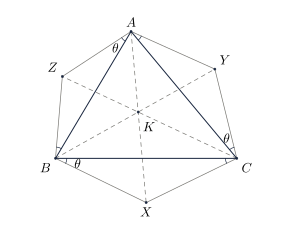
Construct similarly oriented similar isosceles triangles XBC,YCA,ZABXBC,YCA,ZAB externally on the sides BC,CA,ABBC,CA,AB of a triangle ABCABC. Then the lines AX,BY,CZAX,BY,CZ are concurrent at a point KK, the corresponding Kiepert point.

Triangle ABC with three similarly oriented similar isosceles triangles constructed externally, and the lines AX, BY, CZ meeting at K.
Figure 1. Equal base angles produce Kiepert’s three concurrent lines.

Let θ\theta be their common base angle. This is the equal-angle case α=β=γ=θ\alpha=\beta=\gamma=\theta of Jacobi’s theorem proved below.

Jacobi’s theorem

The three paired angles need not be equal.

Theorem

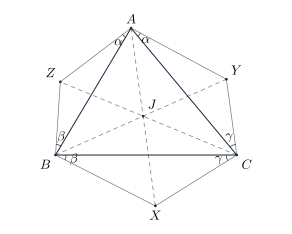
Construct the external triangles XBC,YCA,ZABXBC,YCA,ZAB so that

∠ZAB=∠YAC=α,∠XBC=∠ZBA=β,∠YCA=∠XCB=γ.\angle ZAB=\angle YAC=\alpha, \qquad \angle XBC=\angle ZBA=\beta, \qquad \angle YCA=\angle XCB=\gamma.

Then the lines AX,BY,CZAX,BY,CZ are concurrent at a point JJ, called the Jacobi point.

Triangle ABC with three external points X, Y, Z, paired angles alpha, beta, gamma, and the lines AX, BY, CZ meeting at J.
Figure 2. Jacobi’s paired angle conditions give the concurrence of AX, BY, CZ.

Proof

Write A,B,CA,B,C also for the angles of the triangle. In BXCBXC, the sine rule gives

BXCX=sin⁡γsin⁡β.\frac{BX}{CX}=\frac{\sin\gamma}{\sin\beta}.

Because the construction is external,

∠ABX=B+β,∠ACX=C+γ.\angle ABX=B+\beta, \qquad \angle ACX=C+\gamma.

Applying the sine rule in ABXABX and ACXACX therefore gives

sin⁡∠BAXsin⁡∠XAC=sin⁡γsin⁡βsin⁡(B+β)sin⁡(C+γ).\frac{\sin\angle BAX}{\sin\angle XAC} = \frac{\sin\gamma}{\sin\beta} \frac{\sin(B+\beta)}{\sin(C+\gamma)}.

Cyclically,

sin⁡∠CBYsin⁡∠YBA=sin⁡αsin⁡γsin⁡(C+γ)sin⁡(A+α),\frac{\sin\angle CBY}{\sin\angle YBA} = \frac{\sin\alpha}{\sin\gamma} \frac{\sin(C+\gamma)}{\sin(A+\alpha)},

and

sin⁡∠ACZsin⁡∠ZCB=sin⁡βsin⁡αsin⁡(A+α)sin⁡(B+β).\frac{\sin\angle ACZ}{\sin\angle ZCB} = \frac{\sin\beta}{\sin\alpha} \frac{\sin(A+\alpha)}{\sin(B+\beta)}.

Multiplying these three identities gives

sin⁡∠BAXsin⁡∠XACsin⁡∠CBYsin⁡∠YBAsin⁡∠ACZsin⁡∠ZCB=1.\frac{\sin\angle BAX}{\sin\angle XAC} \frac{\sin\angle CBY}{\sin\angle YBA} \frac{\sin\angle ACZ}{\sin\angle ZCB} =1.

Trigonometric Ceva therefore proves that AX,BY,CZAX,BY,CZ are concurrent at the Jacobi point JJ.

Setting

α=β=γ=θ\alpha=\beta=\gamma=\theta

gives Kiepert’s theorem.

□

Kariya’s theorem

Kariya’s theorem is a direct instance of Jacobi’s paired-angle construction.

Theorem

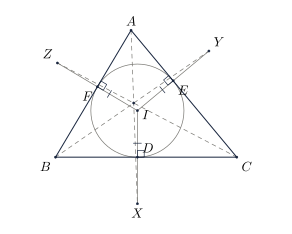
Let the incircle of ABCABC, with center II, touch BC,CA,ABBC,CA,AB at D,E,FD,E,F, respectively. On the rays ID,IE,IFID,IE,IF, beyond D,E,FD,E,F, choose X,Y,ZX,Y,Z so that

IX=IY=IZ.IX=IY=IZ.

Then the lines AX,BY,CZAX,BY,CZ are concurrent.

Triangle ABC with incircle center I and contact points D, E, F; points X, Y, Z lie beyond the contact points with IX, IY, IZ equal, and the dashed lines AX, BY, CZ meet at one point.
Figure 3. Kariya’s construction realizes Jacobi’s paired-angle conditions.

Proof

Reflection in the angle bisector BIBI maps DD to FF and the ray IDID to the ray IFIF. Since IX=IZIX=IZ, it maps XX to ZZ, and hence

∠XBC=∠ZBA.\angle XBC=\angle ZBA.

Cyclically,

∠YCA=∠XCB,∠ZAB=∠YAC.\angle YCA=\angle XCB, \qquad \angle ZAB=\angle YAC.

These are Jacobi’s three paired-angle conditions, so AX,BY,CZAX,BY,CZ are concurrent.

□

If the common distance is allowed to equal the inradius, then X=DX=D, Y=EY=E, and Z=FZ=F; the concurrence point is the Gergonne point.