Classical

Tangents, Angle Bisectors, and a Common Point

A barycentric route to X(55)

A barycentric calculation locates the common point of three lines joining tangent intersections to angle-bisector traces, then identifies it as the isogonal conjugate of the Gergonne point.

Methods Barycentric coordinates · Angle-bisector theorem · Circle tangents · Isogonal conjugation

The configuration

Theorem

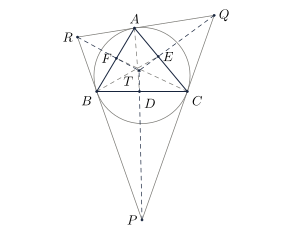
Let the internal angle bisectors of triangle ABCABC meet BC,CA,ABBC,CA,AB at D,E,FD,E,F, respectively. Let the tangents to the circumcircle at B,CB,C meet at PP, those at C,AC,A at QQ, and those at A,BA,B at RR. Then the lines

PD,QE,RFPD,\qquad QE,\qquad RF

are concurrent.

Triangle ABC with its circumcircle, tangent intersections P, Q, R, angle-bisector traces D, E, F, and the lines PD, QE, RF meeting at T.
Figure 1. The lines joining the tangent intersections to the corresponding angle-bisector traces meet at T.

A barycentric calculation

Use homogeneous barycentric coordinates with respect to ABCABC, and write

a=BC,b=CA,c=AB,s=a+b+c2.a=BC,\qquad b=CA,\qquad c=AB,\qquad s=\frac{a+b+c}{2}.

By the angle bisector theorem,

D=(0:b:c).D=(0:b:c).

The circumcircle has equation

a2yz+b2zx+c2xy=0.a^2yz+b^2zx+c^2xy=0.

Its tangents at BB and CC are

c2x+a2z=0,b2x+a2y=0,c^2x+a^2z=0, \qquad b^2x+a^2y=0,

so

P=(−a2:b2:c2).P=(-a^2:b^2:c^2).

The line PDPD therefore has equation

b−ca2x+yb−zc=0.\frac{b-c}{a^2}x+\frac{y}{b}-\frac{z}{c}=0.

The squared side lengths in the tangent-intersection coordinates suggest setting

u=xa2,v=yb2,w=zc2.u=\frac{x}{a^2},\qquad v=\frac{y}{b^2},\qquad w=\frac{z}{c^2}.

The equations of PD,QE,RFPD,QE,RF then become

b(u+v)=c(u+w),c(v+w)=a(u+v),a(w+u)=b(v+w).\begin{aligned} b(u+v)&=c(u+w),\\ c(v+w)&=a(u+v),\\ a(w+u)&=b(v+w). \end{aligned}

Thus

u+v:v+w:w+u=c:a:b.u+v:v+w:w+u=c:a:b.

Recovering the individual coordinates gives

u:v:w=(b+c−a):(c+a−b):(a+b−c)=(s−a):(s−b):(s−c).u:v:w = (b+c-a):(c+a-b):(a+b-c) = (s-a):(s-b):(s-c).

Hence the three lines meet at

T=(a2(s−a):b2(s−b):c2(s−c)).T= \bigl( a^2(s-a): b^2(s-b): c^2(s-c) \bigr).

Recognizing the point

In barycentric coordinates, isogonal conjugation takes

(x:y:z)⟼(a2x:b2y:c2z).(x:y:z) \longmapsto \left( \frac{a^2}{x}: \frac{b^2}{y}: \frac{c^2}{z} \right).

Consequently,

T∗=(1s−a:1s−b:1s−c).T^*= \left( \frac1{s-a}: \frac1{s-b}: \frac1{s-c} \right).

These are the coordinates of the Gergonne point, where the lines joining the vertices to the opposite incircle contact points meet. Thus TT is its isogonal conjugate.

In Kimberling’s Encyclopedia of Triangle Centers, TT is X(55)X(55), the internal center of similitude of the circumcircle and incircle.