Solution

A Solution to Crux Mathematicorum Problem 5031

Crux Mathematicorum Problem 5031, followed by an incircle-inversion proof using contact-chord midpoints and a cyclic quadrilateral.

Methods Circle inversion · Cyclic quadrilaterals · Contact-chord midpoints

Problem 5031

Proposed by Tran Quang Hung

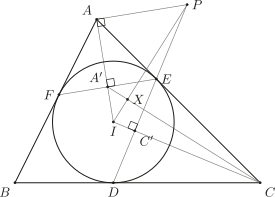
Given a triangle ABCABC with incircle (I)(I) touching the sides BCBC, CACA, and ABAB at DD, EE, and FF, respectively. The line through AA parallel to EFEF intersects DEDE at PP. Prove that the line through CC and perpendicular to IPIP bisects the segment EFEF.

Solution

Proof

Invert with respect to the incircle of △ABC\triangle ABC, and denote the image of any point YY by Y′Y'. Basic inversion properties give the following:

  • A′A' is the midpoint of EFEF.
  • C′C' is the midpoint of DEDE.

Let XX be the intersection of IPIP and A′CA'C.

Triangle ABC with incircle contact points D, E, and F. A prime and C prime are the midpoints of EF and DE; P lies on DE and on the line through A parallel to EF; X is the intersection of A prime C and IP.
Figure 1. The incircle and auxiliary lines used in the inversion.

Under the inversion, the line A′CA'C maps to the circumcircle of △AC′I\triangle AC'I, whereas the line IPIP maps to itself.

Since AP∥EF⊥AIAP\parallel EF\perp AI, we have ∠IAP=90∘\angle IAP=90^\circ. Also, P,C′∈DEP,C'\in DE and IC′⊥DEIC'\perp DE, so ∠IC′P=90∘\angle IC'P=90^\circ. Thus the points AA, C′C', II, and PP are concyclic. Therefore, we have X′=PX'=P.

Consequently, the points AA, A′A', PP, and P′(=X)P'(=X) are concyclic; indeed, if rr is the inradius, then IA⋅IA′=IP⋅IP′=r2IA\cdot IA'=IP\cdot IP'=r^2.

Since AA′⊥APAA'\perp AP, we have ∠A′AP=90∘\angle A'AP=90^\circ. Hence ∠A′XP=90∘\angle A'XP=90^\circ. Since A′A', XX, CC are collinear and II, XX, PP are collinear, it follows that CA′⊥IPCA'\perp IP, which completes the proof.

□