Problem 5021
Proposed by Tran Quang Hung
Let and be two equilateral triangles oriented in the same direction, with centers and , respectively. The lines and intersect the lines and at and , respectively. Let be the intersection point of and . Prove that is perpendicular to .
A generalization
The following direct-similarity generalization contains the published problem as the equilateral case.
Proposition
Suppose that with the same orientation, and let and be their circumcenters. Assume that all the points and lines below are well-defined.
The lines and intersect the lines and at and , respectively. Let be the intersection of and . Then is perpendicular to .
Proof
Let be the intersection of and .
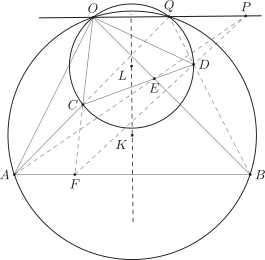
Applying Pappus’s theorem to the two triples and shows that , , and are collinear.
Furthermore, with the same orientation. Indeed, the given direct similarity implies
Hence, working with oriented angles,
and
Consequently, the four points , , , and are concyclic, as are , , , and .
Hence is the radical axis of these two circles and is therefore perpendicular to the line through their centers, namely .
Related notes and diagrams
Radical Axes and Orthogonal Parabolas explains why subtracting two circle equations produces the radical axis used here.