The radical-axis theorem
Theorem
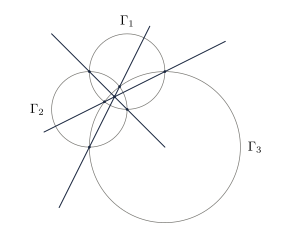
If three circles have three distinct pairwise radical axes, then those axes are concurrent or parallel.
Proof
Write the three circle equations in the form
For each pair, subtracting the two equations eliminates the common quadratic part. Thus
are linear expressions, and the corresponding equations are the three radical axes.
But
If the first two axes meet, their intersection therefore lies on the third. If the first two axes are parallel, their linear parts are proportional, and the identity shows that the third has the same direction. Hence the three radical axes are concurrent or parallel.
Four intersections of parabolas with perpendicular axes
Proposition
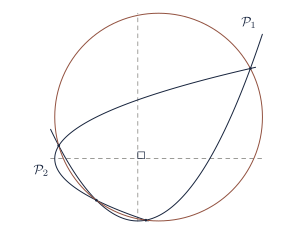
If two parabolas with perpendicular axes intersect at four distinct points, then those four points are concyclic.
Proof
Choose orthonormal coordinates parallel to the two axes. After interchanging the coordinate names if necessary and multiplying each equation by a nonzero constant, the parabolas can be written as
Every common point of the two parabolas satisfies the sum of these equations:
This is the equation of a circle. Hence all four common points are concyclic.
In the first argument, equal quadratic parts cancel; in the second, complementary quadratic parts combine to form .